Theory notes

Important Questions of Monosaccharides (Solved)(Set-1)

Q.1- Discuss in brief about the isomerism in monosaccharides.Answer- The sugar molecules having asymmetric carbon atoms exhibit isomerism. Asymmetric carbon atom- It is the carbon atom that is attached to four different groups. All monosaccharides except- Dihydroxyacetone, have asymmetric carbon atoms. Based on the presence of asymmetric carbon atoms the following types of isomerism of monosaccharides are […]

Important Questions of Monosaccharides (Solved)(Set-1) Read More »
Glycosaminoglycans and proteoglycans – A quick revision

Introduction The most abundant heteropolysaccharides in the body. Highly negatively charged molecules, with extended conformation that imparts high viscosity to the solution. GAGs are located primarily on the surface of cells or in the extracellular matrix (ECM). Along with the high viscosity of GAGs comes low compressibility, which makes these molecules ideal for a lubricating

Glycosaminoglycans and proteoglycans – A quick revision Read More »

Storage Polysaccharides

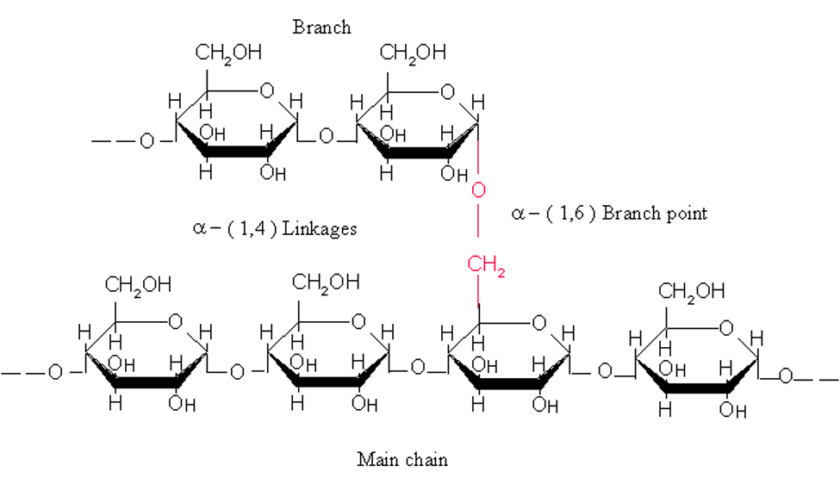
Glycogen, Starch and Inulin are storage polysaccharides. 1) Glycogen  Glycogen is a readily mobilized storage form of glucose. It is a very large, branched polymer of glucose residues (Figure-1) that can be broken down to yield glucose molecules when energy is needed. Most of the glucose residues in glycogen are linked by α-1,4-glycosidic bonds. Branches at

Storage Polysaccharides Read More »

Monosaccharides- Ring structures and Mutarotation

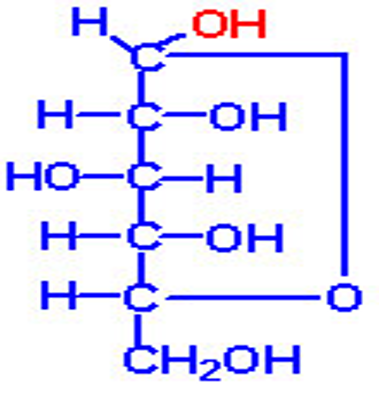
Representation of the ring structure of monosaccharides The ring structures of monosaccharides can be represented as follows : 1) Fischer projection The acyclic structure of a sugar is commonly shown by using a Fischer projection. A Fischer projection is sometimes used to illustrate the cyclic hemiacetal form of sugar. The presence of an aldehyde group and

Monosaccharides- Ring structures and Mutarotation Read More »

Isomerism in Monosaccharides

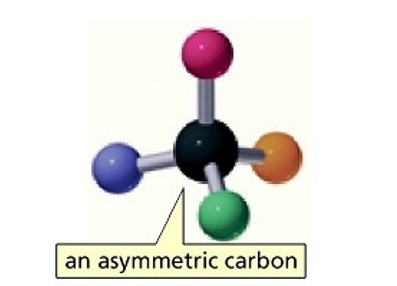
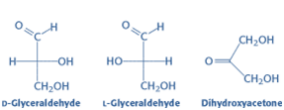
Isomerism in monosaccharides The monosaccharides having asymmetric carbon atoms exhibit isomerism. Asymmetric carbon atom- It is the carbon atom that is attached to four different groups (Figure-1) Figure-1- An asymmetric carbon atom with 4 different attachments All monosaccharides except- Dihydroxyacetone, have asymmetric carbon atoms (Figure-2) Figure-2- Glyceraldehyde has an asymmetric carbon atom whereas dihydroxyacetone lacks, thus

Isomerism in Monosaccharides Read More »

Chemistry of Carbohydrates- classification and significance

 General Introduction Carbohydrates are the most abundant compounds found in nature (cellulose: 100 billion tons annually) They make up most of the organic matter on earth because of their extensive roles in all forms of life. One of the four major classes of biomolecules along with proteins, nucleic acids, and lipids. The term carbohydrate is derived

Chemistry of Carbohydrates- classification and significance Read More »

×